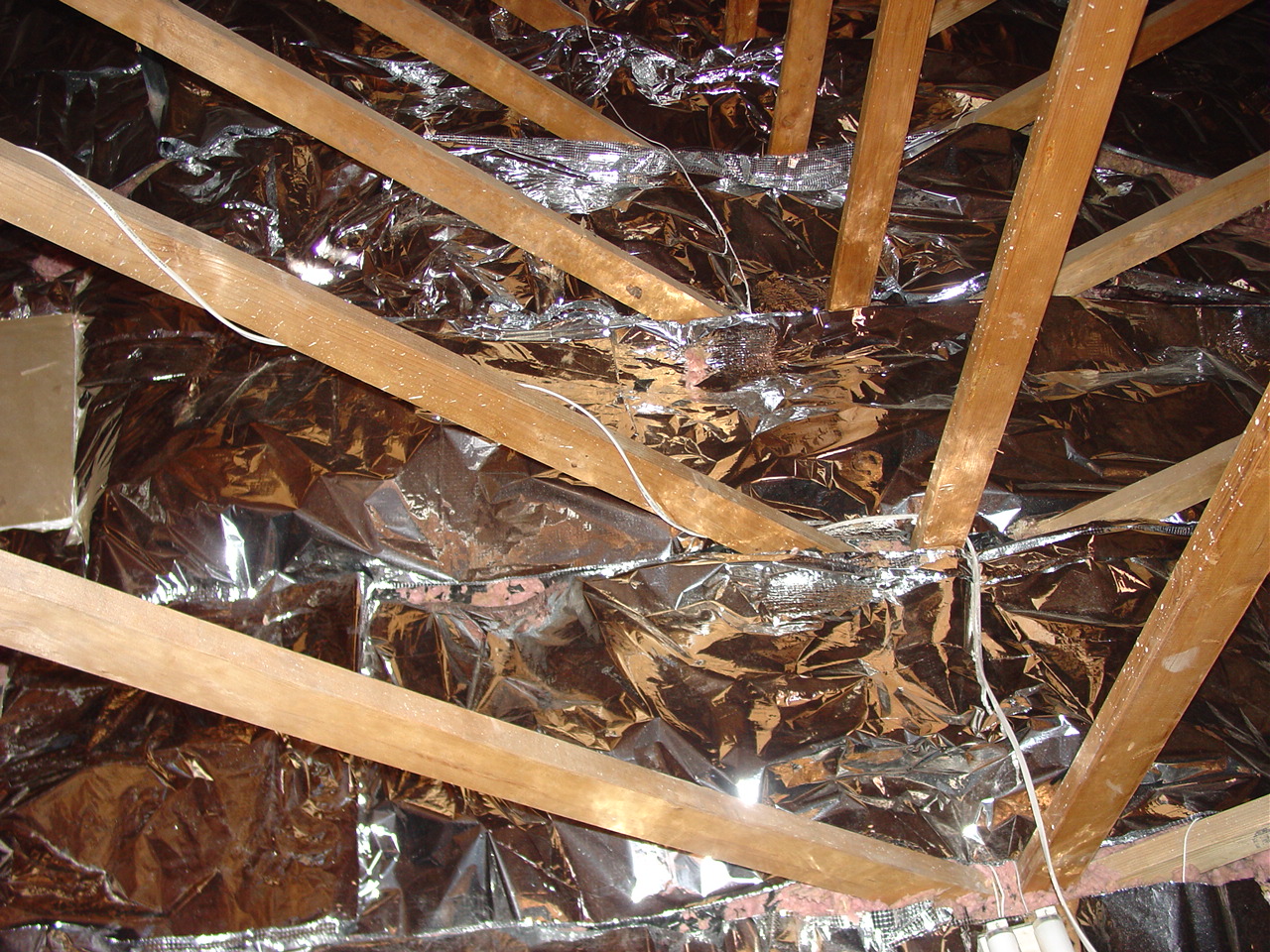
Since the purpose of a radiant barrier is to reflect heat, it stands to reason the more reflective the surface, the better it will perform. Also, testing has shown multiple layers of reflective surfaces work much better than one.
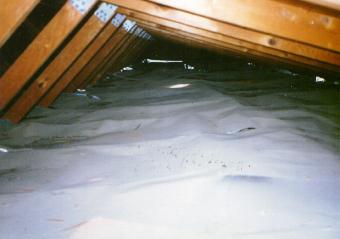
Fact is, dust is the Achilles Heel of all radiant barrier products only having a single membrane. A true radiant barrier, as invented by Sir James Dewar at the turn of the century, is two highly reflective surfaces facing each other with an air space or vacuum in between. Our products are designed this way. Our membranes are not laminated. Laminating a reflective surface to anything reduces the performance by conductivity.3 years of dust on perforated radiant barrier
The radiant barrier you see here was once very reflective. If you look closely you can still see how
reflective it was where the flash hit. This is because it's vertical and dust did not settle on it. The
long thin line at the far end of the attic is the RBS going up the gable wall a few inches, reflecting
light. Light and heat move together at the same speed. The camera easily picked up the once
reflective RBS from the darkest and farthest point from the lens. Infrared heat is the same. Dust
absorbs the light as can be witnessed in this photo and absorbs infrared heat the same way.
Radiant Barrier System Chips (RBS Chips), have been proven to over come the dust problem as
can be seen below.Fact: dust is the Achilles heel of radiant barrier![]()
Here is a picture of RBS Chips installed in the attic of a home in 9/91. What you see here is 15 years of dust accumulation and no reflectivity left to change the direction of IR heat from the roof decking. If this was only one layer it would absorb more infrared heat than reflect it.
Look at the tip of the ball point pen. Still reflective and just like a mirror after 15 years of being in a dusty attic. Lifting up just the first layer of the RBS Chips shows that the second layer, just below it, is still as reflective as the day it was installed. Going deeper would be cleaner yet. This clearly shows why investing in the RBS Chips, even though more costly, is a sound investment that will last forever. Before you purchase any radiant barrier do some research ask for a sample and ask how it's to be installed. Our products offer a lifetime performance warranty. Invest in your home. Order today! Click here
The multiple layers of Thermal Control Membrane addresses the dust issue
If you are building a new home or remodeling, make sure this product finds
it's way into your home. With rising energy costs, nothing else makes ˘ents.
INFRARED PICTURES! See how heat moves and the effects of dust click here
This dust issue very effectively and quickly negates the performance of radiant barriers rolled out over your existing insulation in vented attics. Proper applications for sheet type radiant barriers include: wall systems, stapled up under flat roofs, NEVER STAPLE UP UNDER A PITCHED ROOF! THIS APPLICATION WILL INCREASE ENERGY USE AND DECREASE COMFORT!
Click here to see why.
This is the logic behind RBS Chips and our TCM product. Dust will settle on the top layer and is
sacrificial to the layers below. RBS Chips and TCM have a lifetime, transferable performance warranty.
RBS Chips is the only recognized radiant barrier for reducing heat loss in the winter. Years of applications have proven the associated problems with blanket or sheet type radiant barriers such as moisture condensation, mold growth and ice formation have been overcome by RBS Chips. Why? Because moisture can easily egress through the many layers of RBS Chips
Be sure to ask about a performance warranty before purchasing radiant barriers.
Contact us if you are a custom home builder, remodeler or a home owner looking to "do it right the first time".![]()
Our performance warranty: click here![]()
Install RBS Chips yourself for a limited time only click here
Thermal Control Membrane click here![]()
If you have any questions Click here to email us
![]()
![]()
602 867 3176![]()
Web page design and maintained by B Rad Design Group
Copyright 1991-2010 Horizon Energy Systems. All rights reserved.
Information in this document is subject to change without notice.
Other products and companies referred to herein are trademarks or
registered trademarks of their respective companies or mark holders.